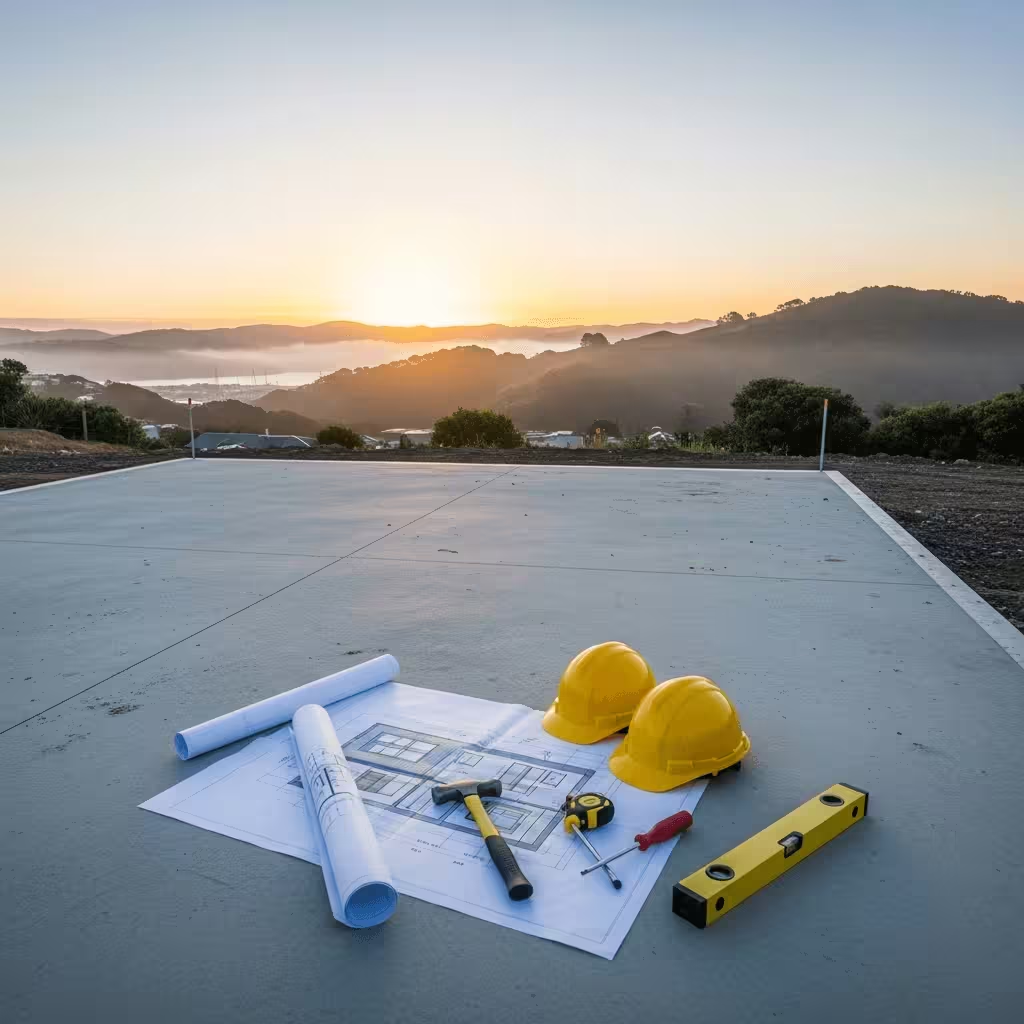
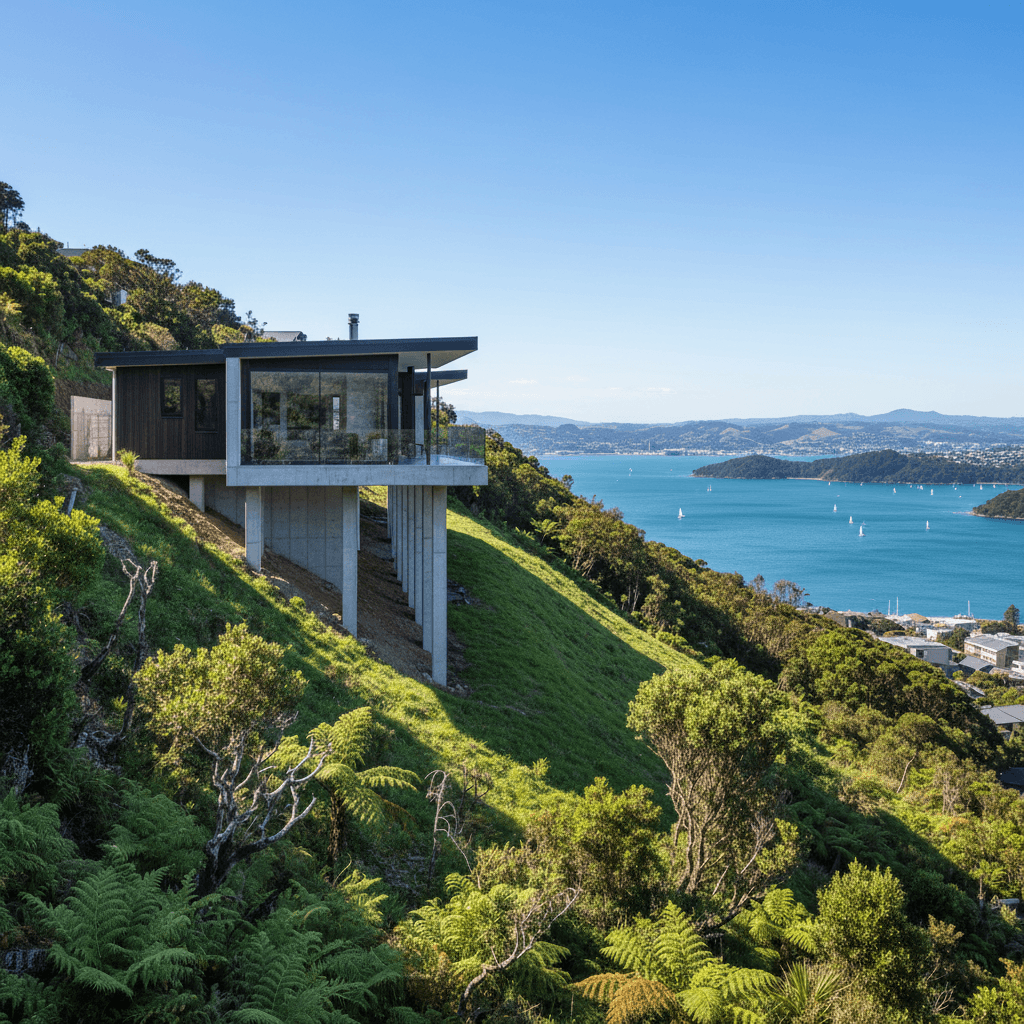
Quick Answer: Building on a slope in Wellington typically costs 20–50% more than building on a flat site, with total build costs ranging from $4,000 to $5,500+ per square metre. The extra expense comes from geotechnical reports, engineered foundations, retaining walls, and stormwater management — all essential for Wellington’s steep, earthquake-prone terrain.
What’s in This Guide
- Why Wellington Has So Many Sloping Sections
- How Much Does Building on a Slope Cost in Wellington?
- Foundation Types for Steep Wellington Sections
- Wellington Council Requirements for Hillside Builds
- The Building Process on a Sloping Site
- How Steep Is Too Steep to Build On?
- Tips for Buying a Sloping Section in Wellington
- Why Choose Clearcut for Your Wellington Hillside Build
- Frequently Asked Questions
Why Wellington Has So Many Sloping Sections
Wellington sits on a series of steep ridgelines and valleys carved by fault lines and ancient waterways. Suburbs like Kelburn, Khandallah, Brooklyn, Karori, and Oriental Bay are all built on hillsides — and those elevated positions are exactly what make them desirable. Higher ground means harbour views, shelter from southerlies, and elevated privacy.
The trade-off is complexity. Nearly 60% of residential sections in Wellington have some gradient, and many of the remaining buildable lots in the city are on slopes that were once considered too difficult. With modern engineering and foundation technology, most of these sections are now viable — but only with the right builder and design team.
Wellington’s unique combination of steep terrain, high seismicity, and variable soil types (from greywacke rock to weathered clay) means every sloping site needs a tailored approach. What works on a gentle grade in Johnsonville won’t suit a steep face in Ngaio.
How Much Does Building on a Slope Cost in Wellington?
The biggest question most Wellington homeowners ask is: how much extra does a sloping site actually add? The answer depends on the gradient, soil conditions, access, and design — but here’s a realistic breakdown of common cost items for hillside builds in the Wellington region.
| Cost Item | Typical Range (2025/26) | Notes |
|---|---|---|
| Geotechnical report | $3,000 – $6,000 | Required for almost all sloped sites |
| Earthworks | $20,000 – $80,000+ | Depends on cut/fill volume and access |
| Retaining walls | $20,000 – $150,000+ | Height and length determine cost |
| Foundations (piles/poles) | $30,000 – $60,000 | Concrete piles on steep sites |
| Stormwater management | $5,000 – $15,000 | Diversion, soak pits, drainage |
| Site access (temp roads, crane) | $5,000 – $25,000 | Narrow Wellington streets add cost |
Overall, building on a slope in Wellington adds 20–50% to the total build cost compared to a flat site. For a typical 180m² new build, that means a flat-site build at $3,500/m² ($630,000) could reach $4,500–$5,500/m² ($810,000–$990,000) on a steep section.
The silver-lining: sloping sections are usually cheaper to buy than flat ones, and the finished home — perched above the street with views — often commands a premium at resale.
Foundation Types for Steep Wellington Sections
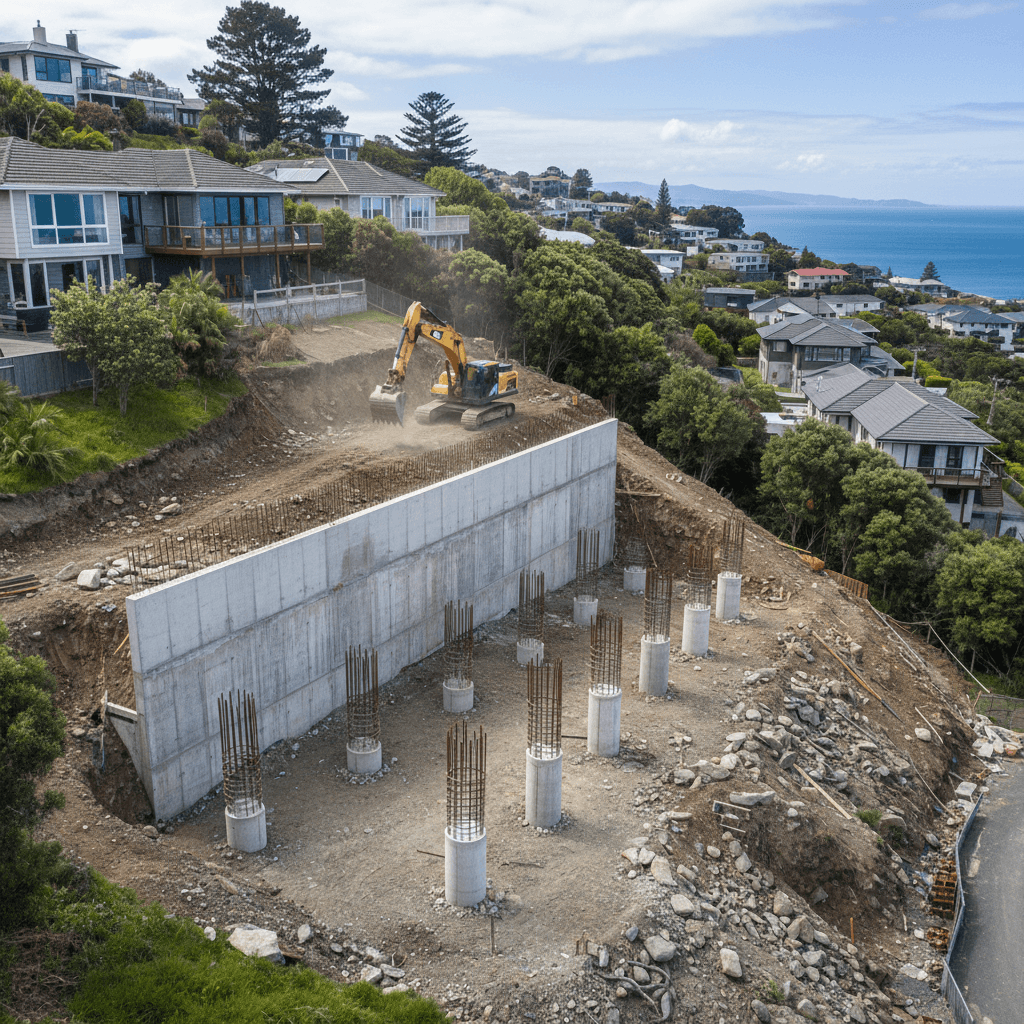
Choosing the right foundation system is the single most important decision on a sloping site. The correct choice depends on gradient, soil type, seismic zone, and what the geotechnical engineer recommends. Here are the main options used in Wellington:
Timber pole/pile foundations — Traditional in Wellington, timber poles are driven or set into the hillside and the house is built above on a suspended floor. Cost-effective for moderate slopes on stable ground, but less common for new builds due to durability concerns and modern seismic requirements.
Concrete pile foundations — The most common choice for steep Wellington sections today. Reinforced concrete piles are drilled into rock or stable ground, supporting concrete beams and a suspended floor. These handle earthquake loads well and suit gradients from 15–35 degrees.
Cut and fill — Part of the slope is cut away and used to fill the lower side, creating a level platform. This works best for moderate slopes (under 15 degrees) where the soil is stable enough to compact. Retaining walls are needed on the cut face. Cost-effective where earthworks access is straightforward.
Suspended concrete floor — A reinforced concrete slab poured over piles, sitting above the natural ground level. Popular on steep sites where a traditional slab-on-ground isn’t possible. Provides excellent seismic performance and creates usable space underneath for garaging or storage.
Split-level design — Rather than fighting the slope, a split-level house steps down the hillside in sections. Each level sits on its own foundation at a different height. This approach minimises earthworks, preserves natural drainage patterns, and works beautifully on gradients of 10–25 degrees.
For sites that need retaining walls alongside the foundation work, the engineering design often integrates both systems to reduce overall cost and construction time.
Wellington Council Requirements for Hillside Builds
Wellington City Council has specific requirements for building on slopes, reflecting the city’s earthquake risk and history of landslides. Understanding these early saves time and money during the consent process.
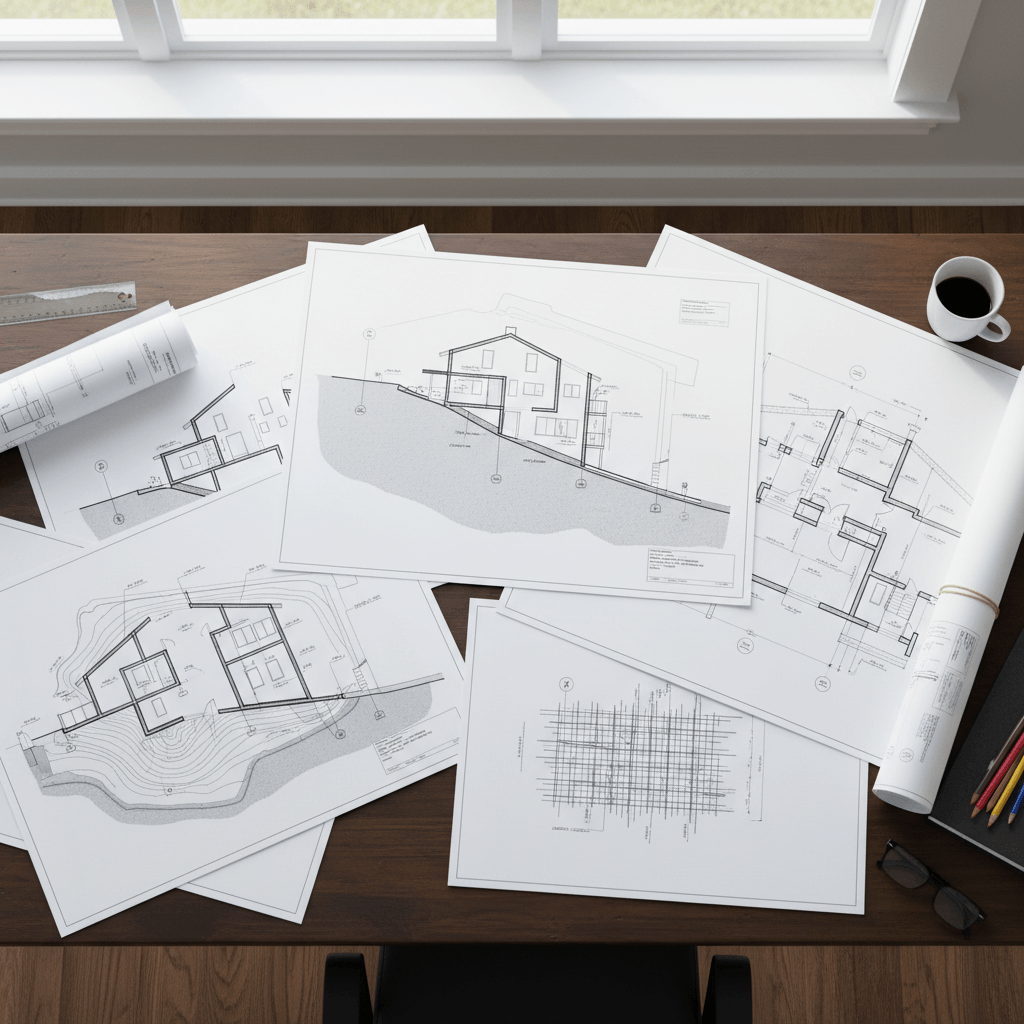
Geotechnical report: Required for virtually all sloping sites in Wellington. A registered geotechnical engineer assesses soil stability, groundwater, slip risk, and foundation recommendations. Budget $3,000–$6,000, and allow 3–4 weeks for the investigation and report.
Engineering producer statements (PS1–PS4): For foundations and retaining walls on steep sites, you’ll need producer statements from a chartered structural engineer. PS1 covers design, PS4 covers construction review. These confirm the work meets NZ Building Code requirements for your specific site conditions.
Stormwater management plan: Sloping sites must demonstrate how stormwater will be managed without causing erosion or affecting neighbouring properties. Wellington Council has specific requirements around hydraulic neutrality — your site can’t discharge more stormwater after building than before.
Resource consent triggers: You’ll likely need resource consent (not just building consent) if your earthworks exceed 250m³, your retaining wall is over 1.5m high near a boundary, or your site sits within a natural hazard overlay. Many Wellington hillside sites trigger at least one of these thresholds.
Natural hazard overlays: Wellington’s District Plan maps fault lines, landslide-prone areas, and flood zones. If your site falls within these overlays, additional assessment and mitigation measures are required. Check the WCC GIS maps before you purchase a section.
Seismic design requirements: Wellington sits in NZ’s highest seismic zone (Zone 0.4 under NZS 1170.5). Every foundation, retaining wall, and structural element must be designed for this. It’s one reason Wellington hillside builds cost more than similar slopes in Canterbury or Waikato — the engineering demands are simply higher.
The Building Process on a Sloping Site
Building on a slope follows the same general sequence as any new build, but several stages take longer and need more coordination. Here’s a realistic timeline for a Wellington hillside project:
Step 1: Site survey and topographic mapping (1–2 weeks) — A registered surveyor maps the contours, boundaries, and existing features. This informs every decision that follows.
Step 2: Geotechnical investigation (3–4 weeks) — Bore holes, test pits, and soil analysis. The geotech report determines what foundation types are viable and identifies any slip or instability risks.
Step 3: Architectural design (6–10 weeks) — With survey and geotech data in hand, your architect designs a home that works with the slope rather than against it. Good hillside architects integrate foundation, retaining, and drainage solutions into the design from day one.
Step 4: Building and resource consent (8–14 weeks) — Wellington City Council processes building consents within 20 working days by statute, but hillside builds with resource consent components often take longer. Allow 8–14 weeks total.
Step 5: Earthworks and site preparation (2–6 weeks) — Excavation, cut and fill, temporary retaining, and access road construction. This stage is heavily weather-dependent in Wellington — plan for delays between May and September.
Step 6: Foundations and retaining walls (3–6 weeks) — Pile driving or drilling, concrete pours, and retaining wall construction. Engineering inspections happen at hold points throughout.
Step 7: Build (20–30 weeks) — Framing through to completion. On hillside sites, material delivery and crane access can slow progress compared to flat sites.
Total timeline: 14–18 months from survey to completion is typical for a Wellington hillside new build. Steeper, more complex sites can push past 20 months.
How Steep Is Too Steep to Build On?
Not every slope is equal. The gradient of your section directly affects construction complexity, cost, and whether the project is feasible at all.
| Gradient | Classification | Cost Impact | Notes |
|---|---|---|---|
| Under 10% | Gentle | +5–15% | Minimal extra foundation work |
| 10–20% | Moderate | +20–30% | Retaining walls and piled foundations likely |
| 20–30% | Steep | +30–50% | Specialist engineering essential |
| Over 30% | Very steep | +50%+ | Feasibility assessment needed first |
Sections over 30 degrees (roughly 58% gradient) aren’t automatically unbuildable, but they require specialist geotechnical and structural engineering before you commit to purchasing. The cost premium can be significant, and some insurers add exclusions for very steep sites.
In Wellington, many desirable hillside suburbs have sections in the 10–25% gradient range — steep enough to need proper engineering, but absolutely viable with the right design approach and experienced builder.
Tips for Buying a Sloping Section in Wellington
If you’re looking at sloping land in Wellington, do your homework before signing a sale and purchase agreement. A few thousand dollars in due diligence can save tens of thousands in unexpected costs.
Get a pre-purchase geotech assessment. Even a desktop study ($500–$1,000) can flag major red flags like historical landslips, problematic soil types, or proximity to fault lines. A full investigation before purchase is even better.
Check the natural hazard overlays. Wellington City Council’s GIS maps show fault lines, flood zones, and landslide-prone areas. A section inside multiple hazard overlays will face additional consent requirements and may be difficult to insure.
Assess vehicle access. Can a concrete truck, crane, or digger reach the site? Many Wellington hillside streets are narrow and winding. Poor access adds significant cost — materials may need to be craned in or hand-carried, and concrete may need pumping from a distance.

Look at the neighbours. Are adjacent properties on piles? Are there existing retaining walls in good condition? Signs of ground movement on neighbouring properties (cracked walls, leaning fences, slumping gardens) are red flags for your site too.
Understand the orientation. North-facing slopes are ideal for passive solar gain and light. South-facing slopes are colder, darker, and may need more insulation and heating — adding to both build and running costs.
Budget for the unknowns. Hillside builds in Wellington have more variables than flat sites. Build a contingency of at least 10–15% into your budget for unexpected ground conditions, weather delays, or additional engineering requirements.
Why Choose Clearcut for Your Wellington Hillside Build
Building on a slope in Wellington demands a builder who genuinely understands the terrain. Clearcut has completed new home builds across Wellington’s hillside suburbs — from steep pole foundations in Brooklyn to split-level designs in Khandallah and exposed sites in Island Bay.
As NZ Certified Builders, every Clearcut project comes with a 10-year Halo residential building guarantee. We work closely with experienced Wellington architects and engineers who specialise in hillside design, ensuring the foundations, retaining, and drainage are right from the start.
Whether you’re building your first home on a challenging section or considering home renovations on an existing hillside property, we can guide you through the process from feasibility assessment to handover.
Frequently Asked Questions
Does building on a slope cost more?
Yes. Expect to pay 20–50% more than an equivalent flat-site build. The additional cost covers geotechnical investigation, engineered foundations, retaining walls, earthworks, and stormwater management. A 180m² home on a moderate slope in Wellington typically costs $4,000–$5,000 per square metre, compared to $3,200–$3,800 on flat ground.
Do I need a geotechnical report to build on a slope in Wellington?
Almost certainly. Wellington City Council requires a geotechnical report for most sloping sites. The report assesses soil stability, groundwater, slip risk, and earthquake vulnerability, and it determines what foundation types are suitable. Budget $3,000–$6,000 and allow 3–4 weeks.
Can I build on a section steeper than 30 degrees?
It’s possible but requires specialist engineering assessment before you commit. Very steep sites (over 30 degrees) need detailed geotechnical investigation, bespoke foundation design, and often face additional resource consent requirements. Some insurers also impose exclusions for very steep properties.
How long does consent take for a steep site in Wellington?
Building consent alone takes 20 working days by statute, but hillside builds often need resource consent for earthworks or retaining walls, which adds 6–10 weeks. Combined, allow 8–14 weeks for the full consent process. Complex sites with multiple hazard overlays can take longer.
What foundation is best for a Wellington hillside?
Concrete pile foundations are the most common choice for steep Wellington sections. They’re drilled into rock or stable ground, handle earthquake loads well, and suit gradients from 15–35 degrees. However, the best foundation for your site depends on the geotechnical report — cut and fill, split-level, or suspended floors may be more appropriate.
Can you renovate a house on poles?
Yes. Many older Wellington homes sit on timber poles. Renovations can include re-piling (replacing timber poles with concrete), extending the footprint, adding rooms underneath, or lifting the house to create additional levels. Each project needs engineering assessment to confirm the existing poles and ground can handle the additional loads.